

AI and Virtual Reality in Education: Building More Practical Learning Experiences
Artificial intelligence and virtual reality are helping education move beyond passive digital content by supporting personalised guidance, realistic practice and more engaging learning experiences.
AI and Virtual Reality in Education: Building More Practical Learning Experiences
Education technology has changed rapidly over the past few years. Online learning platforms, video lessons and digital assessments have made information easier to access, but access alone does not guarantee understanding. Learners still need opportunities to ask questions, practise skills, make mistakes and connect ideas to situations they may encounter outside the classroom.
Artificial intelligence and virtual reality are increasingly being used together to support this kind of learning. AI can help personalise content, identify areas where a learner may need more support and provide feedback at the right time. Virtual reality can place learners inside realistic environments where they can explore, practise and build confidence through experience.
Used carefully, these technologies can make learning more active. Instead of only reading about a process, a learner can step into a simulated workplace. Instead of watching a video about a historical site, they can explore a digital reconstruction. Instead of receiving the same revision material as everyone else, they can receive guidance based on the areas they need to improve.
The purpose is not to replace teachers, lecturers or trainers. Human educators remain essential for explanation, encouragement, judgement and meaningful feedback. AI and VR can support their work by giving learners more ways to engage with content and practise skills in a structured environment.
Why Learning Needs More Than Digital Content
Digital learning has made education more flexible. Students can watch lectures, access notes and complete activities from different locations. This is useful, but it can also create a passive learning experience when the main activity is simply reading or watching.
Many subjects require more than information. Learners may need to understand scale, movement, decision-making, communication or physical processes. These concepts can be difficult to explain through flat images and text alone.
Virtual reality can help by creating a sense of presence. A learner can look around a space, inspect objects from different angles and respond to a situation as it develops. This can be useful in science, healthcare, technical training, history, construction, tourism and many other fields where context matters.
Learning Through Safe Practice
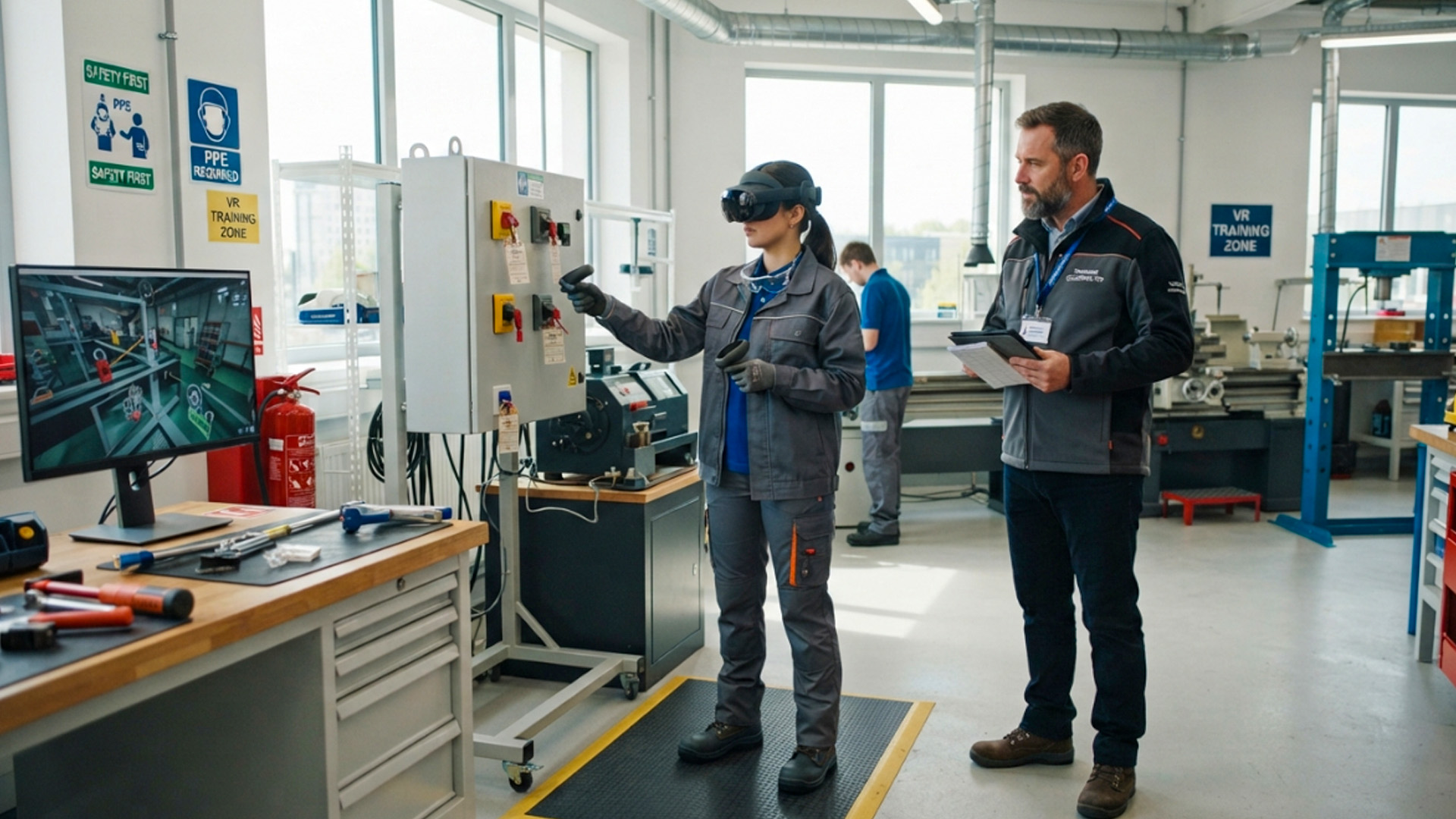
One of the strongest uses of VR in education is practical training. Some skills are difficult to practise repeatedly in the real world because equipment is expensive, environments are risky or opportunities are limited.
A learner can use VR to practise a procedure before working with real equipment. They can repeat the activity, make mistakes without serious consequences and receive guidance before trying again. This can help build familiarity and confidence.
For example, technical learners can explore machinery before entering a workshop. Healthcare students can practise communication or emergency scenarios. Construction teams can learn to identify hazards in a simulated site. Hospitality learners can experience customer-service situations that require calm decision-making.
The virtual environment does not replace practical assessment. It prepares learners to approach real-world work with a better understanding of what they need to do.
Making Complex Ideas Easier to See
Some topics are difficult because they involve things that learners cannot easily see. A biology student may need to understand the structure of a cell. An engineering student may need to inspect the inside of a machine. A geography class may need to understand how a landscape changes over time.
VR can make these concepts more visible. Learners can walk around a 3D model, observe relationships between objects and explore a process from different viewpoints. This can support explanation by making abstract ideas feel more concrete.
The experience still needs clear learning goals. A visually impressive virtual environment is not automatically educational. The activity should guide learners toward the concept they need to understand and give them time to reflect on what they have seen.
How AI Can Support Personalised Learning
Every learner has different strengths, previous knowledge and confidence levels. In a traditional classroom, it can be difficult for one teacher to provide individual guidance to every student at exactly the right moment.
AI can help educators understand patterns in learner progress. It can identify which topics are causing difficulty, suggest revision material and provide practice questions that match a learner’s current level. This can make learning more focused and reduce the frustration that comes from receiving content that is either too easy or too difficult.
Personalisation should not mean isolating learners or allowing software to make important decisions without oversight. Teachers need to remain involved and should be able to understand how recommendations are being made. AI is most useful when it gives educators better information and gives learners clearer next steps.
Feedback When It Is Most Useful
Feedback has the greatest value when learners receive it close to the moment they need it. If someone completes a task incorrectly, waiting days for a response can make it harder to remember what happened and why it matters.
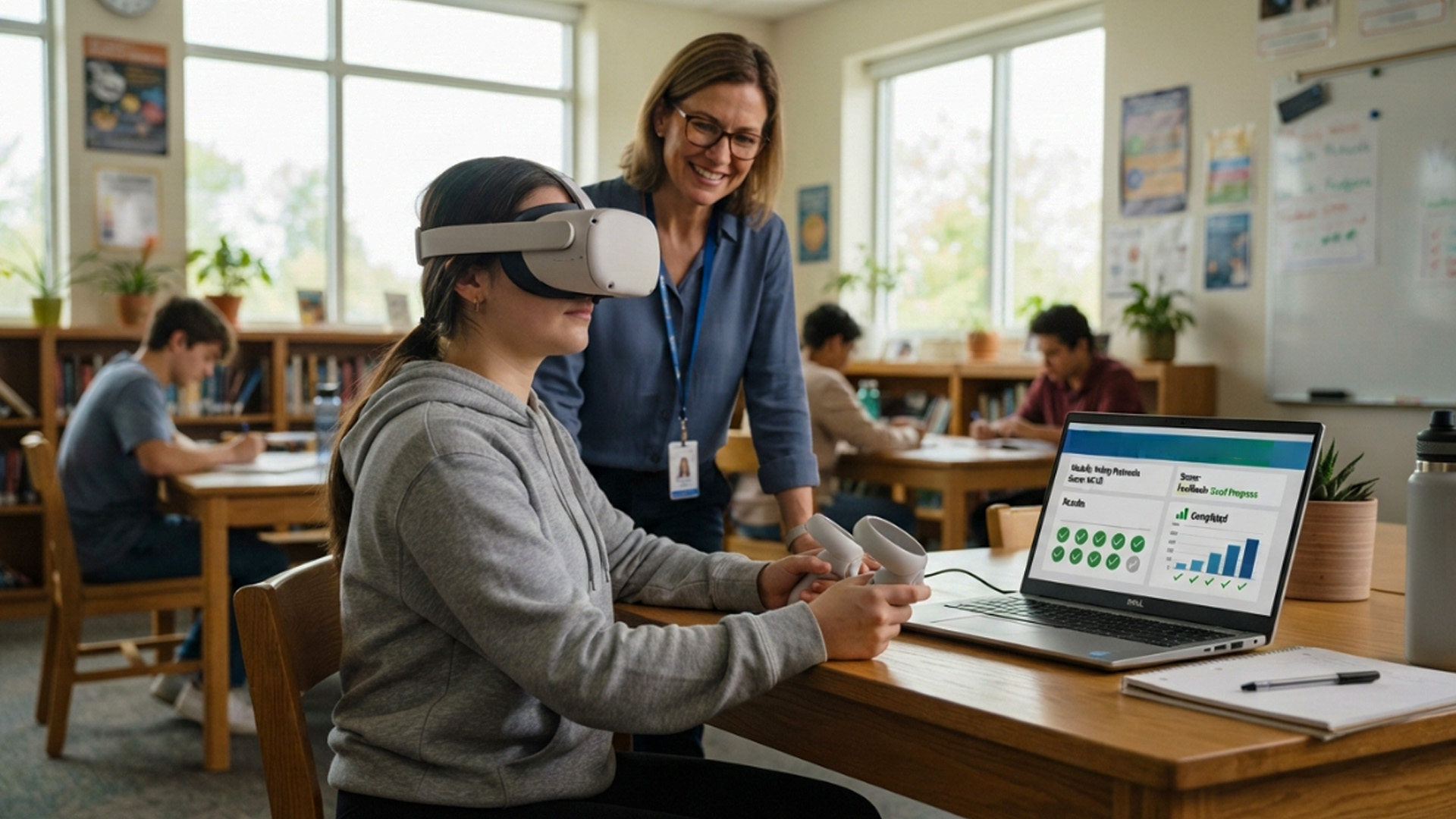
AI-supported systems can provide immediate guidance during a practice activity. In a VR simulation, the system may point out that a learner missed an important safety check, selected the wrong tool or skipped a step. It can then explain the correct action and allow the learner to try again.
This type of feedback can make practice more productive. Learners are not simply told whether they were right or wrong. They can understand the reason behind the result and improve through repetition.
Supporting Teachers Rather Than Replacing Them
Teachers bring context, empathy and professional judgement that technology cannot reproduce. They understand the social dynamics of a classroom, recognise when a learner is struggling for reasons beyond the lesson and help students develop confidence over time.
AI can reduce some routine work by helping with preparation, basic feedback and progress tracking. This can give teachers more time for the parts of education that require human connection.
The strongest approach is collaborative. AI can organise information and suggest possible next steps, while teachers decide what is appropriate for each learner and how the technology fits into the wider learning programme.
Combining AI and VR for Better Simulations
VR becomes more useful when the experience can respond to the learner. A fixed simulation may show the same content to every person. When AI is used carefully, the experience can become more adaptive.
A learner who is new to a topic may receive more guidance, slower pacing and clearer prompts. A learner who already understands the basics may be given more complex decisions or a scenario with fewer hints. This helps make the simulation feel relevant to different levels of experience.
For training organisations, this can make it easier to offer structured practice without creating entirely separate programmes for every learner. The system can record progress, highlight common difficulties and help trainers understand where extra support is needed.
Scenario-Based Learning That Feels Relevant
People often remember learning experiences when they can connect them to a realistic situation. Scenario-based learning gives learners a problem to solve rather than only a list of facts to memorise.
A customer-service learner may need to respond to an unhappy client. A safety learner may need to identify risks before beginning a task. A student studying environmental science may need to explore the impact of different choices on a virtual landscape.
AI can make these scenarios more responsive by adjusting dialogue, outcomes or levels of difficulty. This does not need to create a complicated virtual world. Even small changes can make the learner feel that their decisions matter.
Measuring Progress Beyond Completion
Completing a simulation does not always mean that a learner has understood the material. Education providers need to know whether the activity improved knowledge, confidence or practical ability.
AI-supported analytics can help by showing where learners hesitated, which choices they made and which concepts caused repeated problems. Educators can use this information to improve the lesson, provide targeted support and identify patterns across a class or training group.
Data should always be handled responsibly. Learners need to know what information is collected, why it is collected and who can access it. Educational technology should support learning without creating unnecessary surveillance.

Accessibility, Inclusion and Responsible Use
Technology can create new learning opportunities, but it can also create barriers if it is not designed carefully. Not every learner will be comfortable using a headset, and not every institution will have the same access to equipment, reliable internet or technical support.
A good VR learning programme should include alternatives. A learner who cannot use a headset should still be able to access the core lesson through a screen-based version, video, written material or guided activity. The learning outcome should remain available even when the delivery method changes.
Comfort is also important. VR experiences should avoid unnecessary movement, provide clear ways to pause and use short sessions where possible. Learners should never feel pressured to continue if they experience discomfort.
Protecting Learner Privacy
AI and VR systems can collect information about performance, movement, choices and time spent on an activity. This information can be useful for improving learning, but it also needs careful protection.
Education providers should have clear policies about data collection, storage and access. Learners and parents should understand what is being recorded and how it will be used. Sensitive information should not be collected simply because the technology makes it possible.
Responsible use also includes checking for bias in AI recommendations. If a system consistently gives different types of guidance to different groups of learners, educators need a way to identify and address that issue.
Starting With a Focused Pilot
Schools, colleges and training organisations do not need to transform every lesson at once. A focused pilot can be more useful than a large rollout with unclear goals.
An institution might begin with one subject, one safety module or one practical skill where immersive learning can solve a specific problem. The team can then gather feedback from learners and teachers, review outcomes and decide whether the approach should be expanded.
This allows the technology to be tested in a realistic setting. It also helps organisations understand what support, content and staff training are needed before investing more widely.

A More Practical Future for Education Technology
AI and virtual reality are most valuable when they help learners do something that was previously difficult. They can make training safer, help students explore complex ideas and give educators better ways to support individual progress.
The technology should remain connected to real educational goals. A headset is not a lesson plan, and an AI assistant is not a teacher. Their value comes from thoughtful design, clear outcomes and the people who guide learners through the experience.
As education continues to change, the most useful tools will be the ones that make learning more understandable, more inclusive and more connected to real life. AI can help learners receive the right support at the right time, while VR can give them a place to practise, explore and build confidence before they apply their knowledge in the world around them.
Author: Elisha Roodt
The Virtual Reality Innovation Hub is South Africa's leading intelligence platform for immersive technology, educational innovation, and local developer training programs.